Monday, November 30, 2015

From Fear to Hope

Luke 21:25-36, Advent 1 C, Nov. 29, 2015

When we respond to dangerous situations, we can either respond in fear or hope. For example:

The pastor from Texas responded out of fear, yet the pastor from Rhode Island responded out of hope and love. In our gospel lesson today, Jesus tells us that the world will get worse before it gets better. As we respond to natural and human-made disasters, the world tells us to respond in fear. Yet Christ tells us to respond with love and to live in hope.

Christ calls us to love our neighbors as ourselves. The entire Old Testament proclaims that we are to care for the orphan, the widow, and the alien (foreigner). So, we have an obligation to care for the Syrian refugees. The world tells us to leave them across the world so that we don't welcome any terrorists. That is a fear response. Christ tells us to welcome them here (trusting our government's vetting system to keep us safe). As Lutherans, we proclaim this together: 
The greatest example of moving from fear to hope is found in this video: 

May we have the bravery of this young child to find the hope in these difficult times.
As Christ has taught us, we will stand tall, respond with love, and live in hope. We can do this because of what Christ has already done for us on the cross. Amen.

The Reign of Christ breaking into our lives

John 18:33-37, Christ the King B, Nov. 22nd.

My sermon began with Al's story:
http://themoth.org/posts/stories/love-song-for-malawi

This story tells of what we think of Christ breaking into our lives - those moments when the Lord's presence is so heavy you can't help but notice it.

Sometimes Christ breaking in is more complicated, like the story of Kelly:
#Kellyonmymind
http://www.thelutheran.org/article/article.cfm?article_id=12768

Kelly was executed because the reign of Christ isn't complete yet. The reign of sin and death is still prevalent in this world. We look toward the day when Christ will return, when death will be destroyed for good. We look toward that day with hope and expectation. Amen.

Hannah and Mary

1 Samuel 1-2, 25th Sunday after Pentecost B, November 15, 2015

Grace and peace be unto you from God our Father and our Lord and Savior Jesus Christ, Amen.
It has happened again. Terrorists have struck fear into the hearts of millions as they murdered at least 120 innocent lives in Paris. These extremists carefully chose locations where common citizens would be out enjoying the city. Those murdered were no threat to anyone.

Events like these can seem to be unfathomable. What could bring a group of people to chose to murder so many innocent lives? What could inspire someone to be willing to put on a suicide belt? What horrors must they have faced in their lives to create such horrors in other lives? 

What happened in Paris is a great tragedy. It strikes a bit closer to home because those murdered looked like us. We may not have seen the names and faces of the dead, yet we know that those murdered were out socializing in Paris. So, many most likely were white and moderately wealthy. ISIS intentionally attacked a western nation and threatens more attacks to come. 

The unsettling feeling that this makes in our gut is not dissimilar to what the Israelites experienced during the time of the judges, the time before our first lesson. After the Israelites settled in the Holy Land and before the monarchy was created, the people struggled to stay under control. The book of Judges tells of such atrocities like: 
    • Jael murdering Sisera by nailing a tent peg through his temple
    • Jephthah killing his only daughter as a sacrifice for the Lord
    • A group of men raping and murdering a concubine; then her master cuts her into twelve pieces and sends them across Israel.
After all of these terrible acts, often of violence against or involving women, we then hear the story of Hannah. She is living a comfortable life, happily married. Yet she is barren. Her greatest desire is to have a son. She wants this child not for her own protection or economic support. Instead, she desires a son because she is measured socially by her ability to bear children. Her marriage is not enough - she needs a child.

Hannah needs a child to bring her joy. She may be able to love her step children, but that is not the same as raising her own flesh and blood. Hannah saw how her husband and his other wife drew close as they watched their kids grow from babies to toddlers to children. Hannah wanted to have her own baby to suckle at her breast, her own child to smile at her, her own child to love her so deeply.

When the Lord finally heard her prayers and opened her womb, Hannah somehow knew that this child was destined to greatness. She dedicated her son at the house of the Lord at Shiloh. Her prayer is recorded in chapter two, what we read in place of the psalm. This beautiful poetry proclaims God’s mighty power to overturn the wealthy and lift up the lowly. 

It may seem odd how one little baby can bring so much hope into the world. Can one child really make that much of a difference? Yes. I have seen this in my own family. The Scheibels are a pretty close family. What started as my grandparents, my dad, and his five siblings has grown through the generations to include about 45 aunts, uncles, cousins, and second cousins. We first cousins were each others’ best friends growing up. Even my mom, who divorced out of the family decades ago, continues to be included in all Scheibel events. 

Then, in 2007, everything changed. Our happy family was struck with tragedy when my cousin J died suddenly. Just 30 years old and days before her wedding, a pulmonary embolism took her life. My family was devastated. J’s mother, my Aunt J, hasn’t truly smiled since then. 

The Christmas after J passed away, we found out that my Uncle G had cancer. He passed away in 2009. If that wasn’t enough, about a year after that, J’s dad, my Uncle C, died suddenly, also from a pulmonary embolism. So, over the course of four years, three of my family members died tragically from natural causes.

Needless to say, family parties were a bit more somber after that. My family needed a reason to hope again. We needed to smile. We needed a child in our midst to bring us joy. In November 2011, my nephew L gave that to us. 

With such a happy baby to pass around, we couldn’t help but smile. As he grew, we rejoiced with his progress. As he began to walk and talk, he brought joy into all our lives, even Aunt J. After grieving for her daughter and her husband, she still doesn’t smile much. But at least now she is not overwhelmed with grief when she sees us happy.

One baby can change family dynamics. One child can bring joy where there was only grief and despair. One little one can make a world of difference. Lukas brought some much needed healing to my family. Yet Hannah’s child did so much more.

Samuel grew up to be an important prophet. After the terrors of the judges, Samuel blessed the first kings of Israel, Saul and David. David would then bring peace to the people, a peace the likes of which they would never experience again. Samuel did not bring peace on his own, yet he pointed towards the peace that would come.

It is fitting that the song that Hannah sang when Samuel was born is very similar to the song that Mary sang when she was pregnant with Jesus. Both of these prayers rejoice in the new life found in babies. Both sing of God’s power to bring down the mighty and lift up the lowly. Both proclaim that God is in charge.

We need to hear Hannah’s song just as much as we need to hear Mary’s song. We need to hear that God will make all things right in the end. We need to hear that only God can judge terrorists just as only God can judge any of us. We need to hear of God’s mighty power. Because when terrorists have the ability to destroy anything or anyone, we desperately need to hear that God is in control. 

When Hannah prayed her prayer, Samuel was still a young baby. She could not have known how Samuel would help to change the history of Israel. Even so, she hoped as she prayed. She trusted in the Lord.

When Mary sang her song, she had not yet given birth to Christ. She could not have fully understood how Jesus would change the world. She knew that Jesus was the child of God, yet even she could not know how Jesus would save the world. Even so, she hoped and she trusted God’s word. 


Samuel brought peace to Israel, and Jesus brought salvation to the world. Yet despite all of this, there is still evil all around us, found this week in terrorists. Despite the life that Jesus gives to us, there is still death all around us, stealing away loved ones. We cannot fully experience the salvation that Jesus gives to us until we too face death. In the meantime, we trust in the Lord. We trust that the Lord is enacting justice. We trust that the Lord is in control of our lives and of the world. Most important, we trust that the Lord will give us life everlasting. Amen.

The metaphors of heaven

Revelation 21:1-6, All Saints Sunday B, November 1, 2015

Grace and peace be unto you from God our Father and our Lord and Savior Jesus Christ, Amen.
My father’s father passed away on my thirteenth birthday. While my father’s grief was still fresh, he had a dream of heaven. He fully believes that this vision came directly from God. 

In this vision, my father saw my grandfather in a dorm room, not unlike where my father stayed at the University of Illinois. Grandpa was sitting near his desk, leaning back in a chair reading. Grandpa was content.

Then Walter Payton, the famous Bears player, walked by. He was wearing street clothes, yet he had a football in his hand. Walter leaned in the open dorm doorway and said, “Jack, do you want to go to the tv room with me and watch some football?” My grandpa hopped out of his chair and went along. 

Not too long later, my dad had another dream which was a continuation of this vision. This time, Grandpa was in the cafeteria. He had a tray of food and turned to look where to sit. He saw Abraham Lincoln eating alone, so my grandfather sat down with him. I can only imagine what sort of conversation they had.

For my grandfather, my father, and me, our years in college were like heaven. Being able to read all day, spend time with friends, and have conversations with important people is what it is all about. Yet, when my father described these visions to me, he made it clear that he did not believe that all of heaven is one dorm or even one college. People have their own ideas of what is the perfect place to be. For my dad, this vision is not a literal description of what heaven is like. 

What this vision did for my father, though, is provide some comfort. Even to this day, my dad looks back on these visions with fondness. He knows that his dad is in a better place. He knows that Grandpa is with God. 

To some degree, I think this is what the book of Revelation is all about. It does not describe literally how the world will end, nor does it describe literally what heaven will be like. Instead, it speaks in coded symbolism. Scholars can interpret some of those symbols based on the text’s original context, yet others remain a mystery. Even so, I’m not sure if deciphering the code is the point. If you step back and look at the bigger picture, I believe that the book of Revelation is meant to provide some degree of comfort.

With all this in mind, I am still curious about what John of Patmos means when he says that he saw “a new heaven and a new earth; for the first heaven and the first earth had passed away.” (v. 1) and that God is “making all things new” (v. 5). This author is speaking truth, even if he is not speaking fact. What does a new heaven and a new earth look like?

One commentator online says that the best way to understand this is to read C. S. Lewis’ Chronicles of Narnia. More specifically, The Last Battle describes the end of the Old Narnia and the beginning of New Narnia. Just like Revelation and my Dad’s vision, C. S. Lewis is using metaphor to describe what heaven will be like. Because he wrote a fictional novel, he had more freedom to express his ideas in beautiful, figurative language. Even though Lewis is describing the end of a made up world full of talking animals, his descriptions are spot on. Replace “Narnia” with “Earth” and you get the point.

Lewis describes a severe scene in Old Narnia. A monkey dressed up a donkey in a lion’s skin and tried to pass him off as Aslan, the Jesus figure in these tales. This leads to an epic battle between the true Narnians and the Calormenes who worship an idol. The last king of Narnia left the battle’s end as he saw a mysterious door and walked through it. As he entered New Narnia, he met all of the good kings who had died before him. All of these people were mysteriously ageless, no matter if they died young or old.

Then Aslan appeared in the doorway and called all of creation from Old Narnia to him. He judged these creatures one at a time, although it seemed to not last very long. Aslan sent the wicked into eternal darkness and invited the good through the doorway. Once everyone welcome into New Narnia had entered, King Peter closed the mysterious doorway and took out the key. Old Narnia was gone, and it was time for them all to experience New Narnia. “Come further in! Come further up!” (p. 181) Aslan bellowed.

As the characters moved in and looked around, they marveled at how much everything was so much like Old Narnia while also being so different. The colors were brighter and deeper. The mountain range looked further away and yet…somehow… “more like the real thing.” (p. 193) The land that they had previously experienced was only a shadow of the real dream where they were now.

One of the characters exclaimed, “I have come home at last! This is my real country! I belong here. This is the land I have been looking for all my life, though I never knew it till now. The reason why we loved the Old Narnia is that it sometimes looked a little like this…Come further up, come further in!” (p. 196) 


Then everyone began to run. They felt the rush of air and the joy of moving, yet they never became out of breath or sore. They realized that they could not feel afraid, nor angry, nor sad. They found all of the beloved people and creatures they had met on their previous journeys. This New Narnia truly was heaven, and their new journey had just begun!

We may not know exactly what a new heaven and a new earth will be like, yet we can hope. We can hope that it will be just as exhilarating as C. S. Lewis describes. Maybe everything will be like it was, but richer, deeper, and brighter. No matter what, at the time that we experience heaven, it will be more of everything good because we will be with God. Surrounded by God's love like we have never experienced before, it must be worth it. We hope for the future because of God's promises! Amen.

Thursday, October 29, 2015

Blind Bart and the Luther Rose


Julie Monnard, Zion Lutheran Church
Mark 10:46-52, Reformation Sunday B, October 25, 2015
Grace and peace be unto you from God our Father and our Lord and Savior Jesus Christ, Amen.

In Seminary, I studied this text about blind Bartimaeus for a final project. In addition to the paper, I also had to create some sort of integrative project. I knew that crocheting would take too long, so I decided to paint my learning. 


When Bart cried out, "Jesus, Son of David, have mercy on me!" he was using loaded terms. By calling Jesus "Son of David," he was confessing that he believed all that was told about him in the Old Testament. More specifically, he may have been referencing Psalm 110:1 which is quoted in Mark 12. So, that is what I painted in the speech bubble.

Now, here's the truth: I am not proud of this painting. I wasn't then and I am not now. I don't even want to hang this up in the privacy of my own home.
 
Where's Jesus
A wise pastor friend once taught me that once a canvas has served its purpose, it is time to wipe it clean and start fresh. Some art is not meant to last forever! So, this past week, I did just that. I took this bad painting of blind Bart, painted it white, and started fresh.
 

As I considered what to paint, I thought about blind Bart's confession of faith. If I had to visually confess my faith, what would I use? Well, on this Reformation Day, of course I would use a Luther Rose. Luther put some careful thought into this symbol, and I still stand behind all that it represents. The background is the liturgical calendar. 


Now, I'm still a bad painter. I had more fun figuring out the math of how to get each of the 52 wedges the same size than I did painting it in. I even had to trace the Rose and the Heart! 
This represents for me the cycles of faith and how I experience God in the Lutheran tradition. 
If you had to represent your faith in visual terms, what would you create?


Of camels and needles

Mark 10:17-31, 20th Sunday after Pentecost B, October 11, 2015

Grace and peace be unto you from God our Father and our Lord and Savior Jesus Christ, Amen.

If you don’t feel convicted after listening to this lesson, then you weren’t paying attention. Jesus is speaking some hard words directly to us. Because, let’s be honest, even if you are struggling financially, you are still richer than most of those in this world. Jesus is telling us to sell everything that makes us comfortable and give the money to the poor. 

It is impossible for a rich person to enter heaven just as it is impossible for a camel to fit through the eye of a needle. This statement has made people so uncomfortable over the ages that scholars, pastors, and lay people alike have explained it away. Some have spiritualized it by saying that we don’t really need to sell our possessions. Instead, we need to purge our bad thoughts! When we make this about what goes on inside the individual, then we can easily ignore our homeless brothers and sisters.

Others turned away from spiritualizing the comment. Instead, they want to find a way to get a camel through the eye of a needle. Jesus is using a metaphor to make a statement, so why not make either the camel or the needle metaphorical? For example, some Christians built a small gate in the wall of Jerusalem and called it the eye of a needle. A camel could get through this gate if it was stripped of the loads of stuff it was carrying. Therefore, we don’t need to get rid of all our wealth, just that which is a burden.

More recently, I found a political cartoon on a Google image search which quotes this verse. It shows a camel stuck halfway through a very large needle. A rich man in a top hat watching this distressed camel says, “It’s simple. We’ll buy a bigger needle!” He is hoping to buy his way out of this metaphor and thus completely subverts the point!

Of course, there is the artist who created camels so small that not one but nine camels fit into the eye of a sewing needle. For centuries, rich people have tried to prove Jesus wrong. With each of these examples, it is like we are saying, “Look Jesus! A camel can fit through the eye of a needle. Can I enter heaven now?” I can only imagine Jesus facepalming. 

We don’t get it! Jesus is telling us that it is impossible for us to enter heaven by our own good will. We can’t buy our way into heaven, although the rich man certainly wanted to. Did you notice that in his question? He said, “Good teacher, what must I do to inherit eternal life?” First, he is asking what he can do, implying that he has any authority to earn his way in. Essentially, he thinks God has some massive spreadsheet where God keeps track of everyone’s good and bad deeds. Jesus shows us this isn’t true. 

The second part of the question is specifically about money. The rich man asks about inheriting eternal life. Here, he is referencing the fact that landowners often became wealthy by exploiting the nearby poor landowners. When the poor couldn’t pay back loans tot he wealthy, then the rich could take the poor’s property. It was a way to “inherit” without being a next of kin. This rich man doesn’t just want to earn his way into eternal life, but he wants to buy his way in. How is Jesus supposed to respond to a question that is so off key?

Knowing that this man isn’t ready to hear the truth right away, he eases him in by talking through the commandments. Notice, Jesus never directly states that following the commandments is a prerequisite into eternal life. But they are a way to get closer to God. By following God’s law, this rich man is closer to accepting the good news Jesus has to give.

There is one more step! Clearly, this rich man is relying on his wealth instead of God to get him through life. So, Jesus tells him to sell his possessions and give the money to those in need. That would enable this man to take his focus off himself and put it on another. This is not good news for the rich man, so he went away grieving. He couldn’t bear to stay any longer! He left before he heard the whole story.

I think it is important to note why Jesus said this. Last week, the Pharisees were trying to trick Jesus, so Jesus responded truthfully but harshly. Here, the text says that Jesus loved the rich man. The rich man isn’t trying to trick Jesus; instead he is asking an honest question. Jesus is trying to carefully point this man in the right direction. When he puts his trust in God instead of wealth, then he will be ready to hear the good news. 

When we hear this passage, we often respond either like the people of old who explained away the tough message here, or we also walk away sad and unwilling to hand over our wealth. But not everyone. 

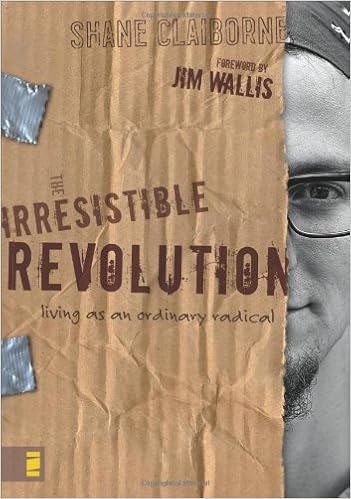
Shane Claiborne is the author of The Irresistible Revolution. In it, he tells of his journey to Calcutta to spend a summer with Mother Teresa. He spent that time helping the sick and homeless have a little dignity in their desperation. He wasn’t the only one serving there, though. He wrote of a man named Andy who worked with him. Shane learned that he used to be a wealthy German businessman until he became a Christian. He took Jesus’ words quite literally. He sold all of his possessions and gave much of it to the poor. Having offered his money to the poor, now he is offering his time and talents. This man made a commitment to the Lord when he agreed to live and work in Calcutta. 


Another example of this was shared at the Why Christian? Conference. Tiffany Thomas is a Baptist pastor in Charlotte, NC. Although she once was on staff at a wealthy congregation, she now serves two poor congregations. Her members live in systemic poverty and face crisis after crisis. Their lives are a mess, yet they always come on Sunday. They need to hear the good news. Offerings at one congregation are only about $200 a week. 

One fall, a local newspaper was interviewing Tiffany. She was talking about the homeless in her neighborhood when she blurted out that her church would be open every night the temperature got below 20. She hadn’t passed that by anybody in her church. She had no plan for how to staff her church to care for these homeless.

Then her janitor stepped up. That entire winter, he slept at the church and let in any homeless who needed a warm place to sleep. That janitor sacrificed so much for the poor.

These are extreme examples, yet I hope you might be inspired to do something extraordinary to follow Jesus’ teaching. Yet even selling everything and giving your money to the poor won’t earn you a place in heaven. Following the commandments won’t earn you eternal life. Even baptism isn’t a free ticket.

So what is Jesus’ good news? He says, “For mortals it is impossible, but not for God; for God all things are possible.”(v. 27) There is nothing that we can do to earn our way into heaven. Nothing. Eternal life is beyond our reach on our own. The good news is that God gifts us with eternal life. God, through the death and resurrection of Jesus Christ, brings us into eternal life. No amount of money, brownie points, or prerequisites can get us there. Only God.


This is the good news. There is nothing that we can do to earn eternal. That is a gift, a gift that we do not deserve, yet a gift that we willingly receive. All that we do is a way to return thanks to God for all that Jesus has done for us. We serve the Lord cheerfully for the grace that Jesus gives to us. Amen.

Divorce wasn't part of God's plan

Mark 10:2-16, 19th Sunday after Pentecost B, October 4, 2015

Grace and peace be unto you from God our Father and our Lord and Savior Jesus Christ, Amen.

I recently read the young adult novel Divergent by Veronica Roth. The main character, Tris, took a test as a teenager to determine what faction she would live in for the rest of her life. The leaders of her city wanted her to fit neatly into their box, yet she didn’t. Her test results showed that she could have fit into multiple factions, marking her Divergent. 

Each time that someone asked her about her test results, she answered truthfully yet differently. When her brother asked right after the test, she said that she wasn’t allowed to talk about it - which is true. Later, after she moved to another faction, her mother found her and asked her test results. Then she said that her results were inconclusive (meaning Divergent), which is true. Towards the end of the book, when the woman hunting Divergents asked of her test results, she said that her result was for her home faction, which is what was manually recorded.

Each time, Tris answered truthfully yet differently. I think that is what Jesus is doing here. The Pharisees are trying to trick Jesus - they want to figure out which faction of Jews he fits into. Jesus can see through their question about divorce, and he answers in a way that does not fit him into a box. Instead of answering directly whether divorce is legal or not, Jesus turns the question on its head. 

Jesus takes a question that is about law and makes it about relationships. Jesus does not state whether a certificate of divorce is legal or not. He does state that God’s original plan was for man and woman to be together forever. Divorce was not part of God’s plan, neither was adultery or homosexuality.


But sin entered the world, so now divorce is a sad reality. The sins that we commit break relationships apart. They separate us from God, and sometimes they force husbands and wives to separate too. Divorce is a sad reality, yet Jesus reminds us of the love that God has for us, from the beginning of creation to today...