Wednesday, April 15, 2015

Easter Day

Mark 16:1-8, Easter Day B, April 5, 2015


Grace and peace be unto you from God our Father and from our Lord and Savior Jesus Christ, Amen.

Mary Magdalene, the other Mary, and Salome collapsed into a heap of wails and tears on that hill named Golgotha. They were quite a distance away from Jesus, safely out of reach of the soldiers. Even so, for all three hours they could hear Jesus' labored breathing and as he cried out. When he breathed his last, their tears grew bigger as their wails grew louder. 

They remained there and watched Jesus' limp body as the soldiers drove a spear into his side. By the time the men took Jesus' body down off the cross, the three women were out of tears. Their emotions moved from uncontrollable crying to sheer numbness. 

When the men were about to take Jesus' body away to the tomb, the women simply stared. They were so numb that they could not move, yet they desperately wanted to follow Jesus' body. Gathering up what little strength she had left, Mary Magdalene grabbed the other Mary and Salome's hands. There was something in that gesture that empowered these women to share their strength. They arose in silence, walking hand in hand as they followed Joseph of Arimathea.

They kept their distance, yet they never let Jesus out of their sight. Once Jesus was safely in the tomb and the stone was rolled to block the entrance, the ladies remained there, hand in hand, until it was almost dark. 

Still in silence, they returned to where the disciples had stayed the night before. The men were nowhere in sight, yet the women were too exhausted to care. They collapsed once more, this time falling into deeply troubled sleep. Not one of those ladies had any actual rest that night.

The next day was the sabbath, so the ladies were limited in what they could do. They found some food and tentatively tried to speak to each other. They wondered about what they saw the day before. How could God's will be done in such a brutal death? What would come from Jesus' crucifixion? That entire day, they did not see any of the disciples.

When evening came and the sabbath was over, the women finally felt safe enough to leave their small dwelling. They thought about Jesus' body in that tomb and couldn't stand the thought that he was not properly prepared for burial. They could not save Jesus from dying, nor could they raise Jesus from the dead. Yet anointing his body with spices was the one thing that they could do. They needed to do this as a part of their grieving process.

So they gathered their money together and headed to the marketplace. They hid their faces so no one could discover their Galilean identity. They found a merchant who sold them the proper spices and scented oils for anointing a dead body. He looked aside at them as they were leaving. They wondered if he suspected who they were, so they rushed off.

Mary Magdalene, Salome, and the other Mary spent one last night in their cramped little space. As they shared a bite of food, they wondered what happened to the disciples. Without their strong fishermen's arms, these ladies had no clue how they would get that massive stone out of the entrance of the tomb. They fell asleep wondering and hoping.

Early the next morning, even before first light, the women awoke with anxious excitement. They continued to grieve for Jesus, and they were looking forward to anointing Jesus' body. So, they gathered up their spices and oils and left their abode for the last time. No matter what happened at the tomb, they were ready to leave Jerusalem.

As they approached the tomb, they noticed something very odd. The stone was on the ground next to the doorway. It was not covering the entrance to the tomb. Something seemed to be faintly glowing inside. Cautiously, nervously, Mary, Mary, and Salome approached that tomb entrance. 

Still standing outside, they all leaned in and poked their heads through the opening. They saw then that the glowing was coming from a young man in a white robe. He was sitting on the right side of the tomb. This man had no wings of course, but his appearance certainly was heavenly. This man must have been an angel.

Seeing the fear in their eyes and in their body posture, this man quickly started talking. "Do not be afraid. I know that you are looking for Jesus of Nazareth, whom you watched be crucified. I smell that you brought spices to anoint his body. Well, I have good news! You no longer need those oils! Jesus isn't here! He has been raised - God raised Jesus from the dead. See for yourself the place where his body was."

At that point, all three women fell on their knees, crossing the threshold of the tomb. They could not believe their eyes. Truly, Jesus' body was not in that tomb! Where could it be, they wondered? Could this young man truly be telling the truth?

Then the women looked back at the young man with hesitant hopefulness written across their faces. He continued, "Go. Tell all his disciples, even Peter, that Jesus is already on his way to Galilee. You will see him in your hometown, just as he told you he would."

Tripping over their own clothes and each other, Mary, Mary, and Salome dropped their spices and ran away. They didn't say a word to each other or to anyone else. They ran out of Jerusalem and followed the path to Galilee. They were going home, home! Where they hoped to be reunited with the disciples. And maybe - just maybe - they would see Jesus too.

"The shorter ending of the sermon"
The original ending of the gospel of Mark states that the ladies said nothing to anyone, for they were afraid. They were afraid for their lives if they would be killed for believing that Jesus was raised from the dead. They were afraid that the disciples would not believe them. They were afraid that the angel had lied.

"The longer ending of the sermon"
But we have the benefit of history. We know from the other gospel accounts that these ladies did see Jesus resurrected. We know that Jesus is alive and that we have new life because of this. We have no reason to be afraid of the good news.


So your task this day and always is to share the good news. Tell everyone you see that Jesus is alive! Live your life every day a bit more joyfully because Jesus has been raised. Heal the sick, feed the hungry, clothe the naked, visit the lonely. Whatever you do, do it in Jesus' name. Because Christ is risen! He is risen indeed! Alleluia! Amen.

Good Friday

John 18:1-19:42, Good Friday B, April 3, 2015

Grace and peace be unto you from God our Father and from our Lord and Savior Jesus Christ, Amen.


On the Moth podcast, Melissa tells her story of the worst day of her life. The day started just like any other. Her father woke up early to work in their field. Her mother woke her seven-year-old self out of bed, followed by her three-year-old sister Heidi. Their baby sister Clara was cooing from the crib.

After the entire family was ready for the day, Melissa’s mother was hurriedly cleaning the house in preparation for the children’s grandmother to visit. Struggling to get anything done with two young daughters underfoot, their mother sent Melissa and Heidi outside to play.

Melissa immediately went to her tree house. Three-year-old Heidi was too young to climb the ladder by herself, so she said, “Up! Help me up!” In a grouchy seven-year-old mood, Melissa sent her sister away to play by herself.

Then, when their grandmother arrived, Melissa’s mother went outside to gather the family. She found Melissa in the treehouse but couldn’t find Heidi. Then, with a scream, their mom saw Heidi floating face down in the pond with her little red boat floating next to her. Heidi died that day.

For the past twenty years, Melissa has wondered, “If only I had helped Heidi up the ladder that day…” Then maybe her parents wouldn’t have divorced. Then maybe their family could have been happy. Then maybe they each wouldn’t have been ripped apart by their grief and guilt.

Now Melissa is married with a three-year-old daughter of her own. The pond in her own back yard freaks her out. With all of her old emotions rushing up again, Melissa talks to her mother. She confesses her guilt that she feels responsible for her sister’s death. 

Then her mother shockingly confesses, “I was the last one that saw Heidi that day. I never told anyone this because I didn’t want your father to blame me. I sent her out to play with her little red boat.” This confession lifted the guilt off of Melissa’s shoulders, yet she could see that her mother still carried that heavy weight of guilt.

Then Melissa talks to her father. He confesses, “[Your mother] wasn’t to blame. I was the last to see Heidi that day. I was working in the garden, and I saw her heading down to the pond with her little red boat. If only I had stopped working and gone down with her, things might have been different.”

So, for over twenty years, Melissa, her mother, and her father each separately bore the weight of guilt for Heidi’s death. They never spoke openly about what happened, so Heidi’s death created a chasm between each of them. They could not express their true feelings, so they stopped talking. Then, after twenty years, they finally were honest with each other. They finally could reconcile. 


We are gathered here to remember not Heidi’s death but Jesus’ death. Like Melissa, her mother, and her father, we each bear some blame for Jesus’ death. Yet, there are more than just three people who hold this guilt.

As we participate in the passion reading, we remembered how that first generation fell under evil’s power and condemned Jesus to death. Yet their words are not just for them. Generations throughout history have recalled and recited these words as well. Now it is our turn to passionately cry out, “Crucify him!” As painful as it is to say these words, it can also be cathartic.

When we shout for Jesus to die, we know that we are condemning ourselves to death as well. We deserve to die, but Jesus does not. As we watch Jesus being crucified on that tree, we see the guilt that we bear in his death.

But we do not bear this alone. If we can learn anything from Melissa, we can see how talking about our guilt and shame is the best way to share our burden. In this service, we all bear part of this guilt, so that no one person is crushed beneath this guilt. For Jesus did not die so that we might be burdened by his death. Instead, Jesus died so that we can be freed by it.

Melissa concluded her Moth talk with these words, “We all think that we need to carry these things alone, that somehow that will make it different. But we don’t need to carry them, and we are not alone…What we can do is to help each other, to love each other during this time we have together.”


Christ died a horrible death, yet his suffering was not in vain. All of the power of sin in the world was destroyed in that one death. Jesus died for us, yet his death is not the end of this story. Amen.

Tuesday, March 24, 2015

Bobby and Brittney

Jeremiah 31:31-34, Lent 5 B, March 22, 2015

Grace and peace be unto you from God our Father and from our Lord and Savior Jesus Christ, Amen.

This weekend, I listened to the Moth podcast, where ordinary people share important true stories from their lives. Some stories are funny and light, while others are deep and engaging. This story is somewhere in between. 

Bobby Stoddard recalls an event from 1999 when he was living in Vermont. He only worked part time, and he spent most of his free time during the winter on the ski slopes. One of his favorite places was an abandoned ski slope. He didn’t mind having to hike up the mountain, and he loved skiing down fresh snow. The powder was better there.

So on that day fifteen years ago, he hiked up the mountain and skied down, enjoying the fresh, powdery snow. When he reached near the bottom, he turned around and looked up - to see how far he had come. To his surprise, he saw a young family about a hundred feet up the mountain from him. These parents and their one year old son were playing with sleds. 

The father pushed his son in the sled to the mother a few feet downhill. She was supposed to catch the sled, but somehow she missed. Their son on his sled continued to slide down the mountain. Being on a ski slope, the sled was gaining speed fast.

Bobby wasn’t sure what to do, but he saw a steel pipe for making snow just a few feet away from him. He was so worried that this little boy would hit the pipe head first. Luckily, the boy’s sled just barely missed that pipe, but it did send the boy flying through the air. Somehow, Bobby caught the boy!

Bobby and the boy were both shocked that they were safe. Then the boy’s father arrived on his sled. Soon after, the boy’s mother arrives as well. She takes her son, and they both fall into a crying mess. So, Bobby and the father talk. After a few awkward exchanges, the father says, “Do you read the Bible?” Bobby is shocked and exclaims, “No!” Then the dad says, “I believe God put you here today to catch my son.”

This caught Bobby off guard. He didn’t know how to respond. He later described it like this, “When someone says something like that to you, you take stock. I started replaying it and the magnitude of it. Then I look up and see that steel pipe coming out of the ground and I picture [the boy’s] little face flying by it. My whole world goes into slow motion. All of my senses become amplified.” For a time after that incident, Bobby became hyper aware of his surroundings. He felt like a superhero, like he could do anything.

I don’t know if Bobby ever attended church after that day, but I can tell you this. On that abandoned ski slope in 1999, Bobby experienced God. God did work through him to save that young child. The boy’s father, who did attend church, saw and proclaimed that situation for what it was - a God moment. Without God working through Bobby, that boy might have died. Bobby described it as feeling like a superhero, but what he was experiencing was the surge of God’s presence.

This is what Jeremiah was talking about when he said, “No longer shall they teach one another, or say to each other, ‘Know the LORD,’ for they shall all know me, from the least of them to the greatest, says the LORD.” (Jer 31:34a NRSV) The day is surely coming when everyone will know the Lord. Not just those who worship the Lord in church, synagogue, or mosque. The day is coming when every single person will know the Lord. 

Then we will all have personal experiences of the Lord’s presence. Then we will all have communal experiences where we see the Lord in each other. The day is coming when every single person on this earth will know that not only does our God exist, but our God loves all of us as well. They day is coming…

But isn’t here yet. Jeremiah says that after the exile the Lord is creating a new covenant with Israel and Judah. The people have broken the ten commandments and sinned greatly, yet the Lord still wants to create a covenant with us. This new covenant, though, can’t be broken. 

The Lord will do more than just teach us who we are and how we should act. This time, the Lord will write it on our hearts. The Lord will reach us at our core, at the center of our being, and claim us as the Lord’s. There is no turning away from this. 

On this Fifth Sunday of Lent, I can’t help but believe that this new covenant has begun with Jesus. Through Jesus’ life, death, and resurrection, we know the Lord better than others have. We begin to experience this new life that Jesus is giving us, a new life that in fleeting moments makes us feel like a superhero. This new life in Christ is what helped Bobby to catch that baby boy. 

Yet even more so, that new life is like what Brittney experiences every day. When Brittney was born in 1990, she had a rare heart disease. Back then, the doctors had no means to correct the disorder. They told Brittney’s parents that she would die. They were at a loss until her mother read about another baby surviving a heart transplant.

Then, twenty-six days after Brittney was born, a baby boy named Danny died in an accident. Graciously, Danny’s parents gave his heart to Brittney. Heart transplants were rare in those days, yet the surgery was a success! Brittney would live.

Now, Brittney is a regular young woman. In high school and college, she competed in track and field. She sends some of her medals to Danny’s family. She writes, “It’s the least I can do considering the life that they have given me…Every time I take my transplant medication, I know I’m a little different—and a lot luckier—than many. I got a second chance, and I want that to mean something. 
So when my friends are hanging out at the mall, my mom and I are often somewhere giving a presentation about the importance of organ donation…It’s hard to believe that someone had to die in order for me to live. I think about that a lot. And I’m trying to make that gift mean something bigger.” http://www.americantransplantfoundation.org/about-transplant/true-stories-about-transplant/brittneys-story/

Brittney literally has a new life because of the sacrifice of another person. She never met Danny, yet she lives because he died. Britney is the living embodiment of what it means to live as a Christian. We too are called to live every day in appreciation for the life that we have because Christ died for us. 


Christ’s death saved more than just one person. We all have new life because of Christ. We are all included in the Lord’s new covenant because of Christ. How do you share your appreciation for your life in Christ? Amen.

Snake on a pole

John 3:14-21, Lent 4 B, March 15, 2015

Grace and peace be unto you from God our Father and from our Lord and Savior Jesus Christ, Amen.

For centuries, snakes have been the caricature of evil. From the serpent in the Garden of Eden to the Loch Ness monster, people have considered them dangerous. Maybe it is because they don’t have legs. Maybe it is how they stick out their tongues, or maybe their dark beady eyes.

Yet today, what interaction do we have with snakes? Pythons and boa constrictors are safely locked away behind glass in zoos. The occasional garter snake in your backyard is harmless. Even a poisonous snake bite is cured with a simple shot of antivenin. For most of us, the modern snake poses no threat. But a member of my internship site would beg to differ.

Lake Gaston

I served in a congregation in North Carolina that was on a man-made lake. There were some poisonous snakes who were native to the dry land before the lake was put in. Water moccasins and diamondbacks also found their way to the area after the lake was built. Because of the property values and the remote location, almost everyone in the congregation was rich and retired.
Susan was no exception. Susan was in her seventies and also recently widowed. She still had a lot of energy for life, and kept busy during the day. But when she was home alone at night, she only had her dog Bella to comfort her. This dog was a peculiar mix of hound and terrier. Everyone else thought that Bella was odd looking, but Susan thought she was truly beautiful. They were the best companions. 

Then one evening after letting Bella out into the yard before bed, Susan heard a hiss followed by a growl. Running barefoot in the dark onto the grassy lawn, Susan found Bella unconscious with two puncture wounds on her face. 

Unsure what to do, Susan called her vet. The recording said that the nearest emergency pet clinic was fifty miles away. So Susan laid Bella in her car and drove to the clinic. The entire time, she was shaking with fear. Could the vet save her dog?

By the time they arrived, Bella’s face was swollen beyond belief. She could barely breathe. Bella was near death but could be saved. Then Susan was faced with the hard decision - would she pay over $500 for the antivenin that might cure her dog or risk losing her dog without it? Thankfully, Susan had the means to pay for that large veterinary bill. She saved her dog that day, but Bella remained sluggish for weeks as she continued to heal from that snake bite. 

Before humans had discovered antivenin, poisonous snake bites were almost certainly fatal. This continues to be true in third world countries, and it was true for biblical times, too.

We hear in the first lesson of the Israelites in the wilderness after the Exodus. Once again, they are complaining about, well, everything. They do not understand why boring manna in the barren wilderness is somehow substantially better than slavery in Egypt. The Lord is so sick of hearing their complaining that he sends poisonous snakes to attack them. 

As their family members are dying of snake bites, the Israelites go to Moses and admit how sinfully wrong they are. “Please Moses,” they cry, “plead to the Lord on our behalf. Have the Lord take away these serpents!” Moses does so. The Lord responds, but not quite how Moses expects. The Lord tells Moses to make a serpent of bronze and set it high on a pole so that all who see it will live.

Is this the solution they were looking for? Not quite. The Israelites asked the Lord to remove the poisonous snakes, but he doesn’t. Yes, the Lord provides a means so they will not die, but the Lord does not remove the cause of their agony. I wonder why?

Certainly if the Lord can provide poisonous serpents out of nowhere, then the Lord can take them away too. Why didn’t the Lord? Was he feeling vindictive? Or were the Israelites not truly repentant? Or was it something else? Scripture doesn't say. 

A lot had changed by the time that Jesus came into the world, and a lot had stayed the same, too. No longer did the Lord resort to sending poisonous serpents to torture the Lord’s people. Yet the people were no less likely to do sinful things and say sinful words. Even so, the Lord devised the perfect final solution. 

The Gospel of John states, "Just as Moses lifted up the serpent in the wilderness, so must the Son of Man be lifted up." (John 3:14 NRSV) Jesus is the solution, and his death on the cross is what gives us life. Just as the Israelites were healed when they looked at the bronze serpent, so also does the Lord heal our bodies and souls because Christ died for us. 

Brian Stoffregen considers what the Lord heals us from. He writes, “If the solution in Numbers was a snake raised up on a pole -- because the problem was poisonous serpents on the ground; so in John if the solution is a human (the Word made flesh) on a pole, the problem must be the humans on the ground. Our problem is that we are human, so a human-being had to be lifted up on the pole (and Christ's divinity makes the effect last for eternity), so that we might look at him and live -- as the ancient Israelites look to the serpent on the pole and were cured from their poisonous bites.” http://www.crossmarks.com/brian/john3x14.htm

Jesus is the ultimate solution. His death was for all, not just those who literally witnessed him on the cross.  Because Jesus died for us, the Lord heals us of a lot more than just snake venom. Instead, the Lord heals us of much more serious venomous things, like greed and envy. The Lord forgives us of our sins and makes us whole again. The Lord restores us to our best, most considerate selves. 

Yet the most important venom that the Lord heals us from is death. Because Christ was lifted upon the cross and then raised to new life, we will never experience the terror of death. Yes, someday we will die, but death will be peaceful. We will then be united with the Lord. What can be better than that?

So, we live on this earth waiting for that day to come. But we are not just biding our time.  

Remember how the Israelites made the Lord grouchy because they complained so much? The least we can do is love the Lord enough to appreciate the abundance that the Lord has given to us. For we are not stuck in a barren wasteland with only stale bread to eat. The Lord has blessed us greatly. The least that we can do is share our abundance with others. 


Jesus offered himself on that cross so that we might live.  When we are bit by the metaphorical venomous snakes in our lives, we only need to look to the cross. The Lord will heal us and strengthen us for the way ahead. And when the end does come, we trust that Jesus will be there to bring us home. Amen.  

Tuesday, March 10, 2015

Community and the Ten Commandments

Exodus 20:1-17, Lent 3 B, March 8, 2015

Grace and peace be unto you from God our Father and from our Lord and Savior Jesus Christ, Amen.


The author of Hyperbole and a Half, Allie Brosh, describes a time from her early childhood. Before going to her grandparents’ house to celebrate her grandfather’s birthday, Allie’s mother made a cake. This was a special cake made of two round layers and covered in icing. Her mother even made animals out of marshmallows and toothpicks to top the cake.

Allie was desperate for this cake. It looked and smelled so good that she wanted to eat the whole thing! And she was determined to do just that. She climbed onto the counter and swiped a handful of cake! After her mom saw her grubby hands go for that cake, she moved it on top of the fridge. Yet four year old Allie was not above climbing the fridge to get at that cake. 

Just in time, Allie’s mom stopped her from reaching it. Somehow, she wrangled Allie away from the cake so that Allie could put on her dress. On the drive to her grandparents’ house, Allie stared longingly at that cake, just out of reach on the passenger front seat.

When they arrived, Allie barely got through hugging her grandparents before she asked for that cake. Allie’s mom was smart enough to lock the cake away in the back bedroom where Allie could not get to it. But Allie was not ready to give up yet! She pleaded and cried and complained to her mother. Allie would not shut up until she got some cake!

Not giving in, Allie’s mom told her to play in the back yard. Allie stood by the sliding glass door screaming and crying and pleading. But then she had an idea! She went over to the back bedroom and happily found that the window was open! Allie carefully removed the screen and climbed into the room. Victorious at last, Allie ate every last bit of that cake. She used her hands to shovel the cake into her mouth.

After she had swallowed every crumb and licked away every last bit of icing, Allie was one happy mess. It was at this point that her mother realized that Allie was being too quiet, which was much more dangerous than her tantrums. Her mother found her in the back bedroom groaning in pain and ecstacy. Allie spent the rest of the evening running around wildly and throwing up that cake, but she was too proud of herself to feel bad about it. http://hyperboleandahalf.blogspot.com/2010/10/god-of-cake.html

Allie’s indiscretion is what you might expect from a young child. Who hasn’t looked at a delectable dessert or an encrusted roast and wanted to eat the whole thing? Unlike young Allie, we know that the social convention of only eating one slice of cake is for our own benefit. Most of us can enjoy the sweet, rich dessert in small amounts without getting sick.

Social conventions like this are often for our benefit as individuals and as a community. As are most rules and laws that we live by. Just as young children do better when they know the daily schedule, we also act better when we know how to act.


This is why the Lord gave the Israelites the ten commandments. The people had just escaped slavery in Egypt. Now they are wandering around the wilderness. Even as they are trying to find the Holy Land, they are also trying to discover their identity. They missed the structured days of slavery. Walking all day was also hard labor, but it was not fulfilling. The Israelites needed direction.

So God gave them the ten commandments. God reminded them who they were as God’s people. God gave them ten basic rules to live by. These set the structure for how they could live as a community. They needed to put God first and their neighbors second. By respecting God and each other, the Israelites could learn how to live as God’s chosen people. 

We continue to hold up the ten commandments as the most important set of rules to live by. They continue to give us a basic structure of how to treat God and each other. That is why the confirmation students study these laws every year. That is why the ten commandments show up in the lectionary four times every three years. These rules are important because they are more than just basic law - they are a covenant. In fact, they are a continuation of the Abrahamic covenant that we heard last week.


This week, I read in the news of a modern day example of a covenantal relationship structured by a set of rules and expectations. This example comes from an unlikely place - a senior living center in the Netherlands. The covenant here is not between the staff and the residents, but between the residents and…the residents! You see, at the Deventer senior home, college students are encouraged to live there too. Those students are allowed to stay rent free as long as they spend at least thirty hours a month with the elderly residents.

The staff takes care of the elderly’s primary physical needs, and the college students provide the companionship that the elderly desire. The youth help the residents go shopping and learn about the internet. One student even brought a group of residents into the garden with cardboard and spray paint to teach them about graffiti. The college students enjoy helping out, and they get more living space than they would in a dorm. Everyone benefits from this intergenerational experience. 

In the big picture, the rules at this senior center are pretty light. The college students have no curfew. They are allowed to drink in their rooms and have friends stay the night. In essence, the students are allowed to still have traditional college habits - as long as they spend an hour a day hanging out with the older residents. The rules provide a gentle structure for everyone to understand their role in this special community. http://www.thejournal.ie/help-the-aged-1814698-Dec2014/

And that is exactly what the ten commandments are supposed to do. Amy Erickson writes, “The commandments, as a whole, present an alternative vision to life in Egypt, a place where there was little interest in regeneration and rest and no freedom… The commandments mean to sketch out a space where human beings can live fruitful, productive, and meaningful lives before God and with one another.” https://www.workingpreacher.org/preaching.aspx?commentary_id=1068 


Putting God in the center of our lives instead of ourselves or our children is a radical change for all of us, yet it is what God calls us to do in the ten commandments. God also calls us to care for our neighbors all the time - not just when it is convenient for us. When we follow these ten simple rules, we might just discover that we are creating the intentional community that Christ intended for us. Right here. Right now. Amen.

Covenantal Membership

Romans 4:13-25, Lent 2 B, March 1, 2015

Grace and peace be unto you from God our Father and from our Lord and Savior Jesus Christ, Amen.


Last Sunday, I mentioned a few symbols of covenants - a friendship anklet, a wedding ring, and a dog tag. These are symbols of personal, intimate relationships I have and the promises that I have made with these people and my dog. 

This week, we hear of Abraham and the covenant that God made with him. The story that we hear from Genesis shows the personal, intimate relationship that Abraham has with God. Once again, God makes these outrageous promises to Abraham. Without question, Abraham believes God. 

Even though he is almost 100 years old and even though Sarah is long past menopause, Abraham trusts God to give them a child. Abraham somehow understands that God can do the impossible.
For Abraham, those symbols of covenant are good illustrations. But then Paul takes this story and expands it beyond the first person to the entire peoples. No longer does Abraham alone experience God’s covenant. Like Abraham, we also have an intimate, personal relationship with God. 

We also have a powerful, corporate relationship with God. God’s covenant is not with us as individuals but as a people. God’s covenant started with Abraham but then extended to all his descendants - to the Jews, to the Muslims, and to us Christians as well.

So, instead of looking at these symbols of personal relationships, I wonder, what are symbols of membership? What do we receive when we join a club or group?


Just looking through my wallet, I found many symbols of membership. There is Portico, who manages my retirement fund. There is my driver’s license, proving that I am a legal citizen of Iowa. There is the card signed by Bishop Burk certifying that I am an ordained pastor. And of course my library card. These and many other cards in my wallet show what groups I belong to. I am sure each of your wallets reveals a lot about who you are.


Some other symbols of membership are more fun. I may only wear my Wartburg College Alumni Association pin when I go to Homecoming, but I often proudly wear clothing emblazoned with Wartburg’s name and logo. I love my alma mater and share it all the time.


Now here’s an interesting symbol of membership: This long pin represents the eleven years that I attended Sunday School at my home congregation. Each year on Mother’s Day, the Sunday School teachers would hand out these pins to children who attended most of the classes during the year. For eleven years, I proudly went before the congregation and received the next piece to add to my pin. This is a symbol of how I spent my formative years learning about God and growing my faith.


I think that Paul would find it odd that we have tokens like this that represent achievements of faith. This pin may be a symbol of faithful membership, but for Paul, faith is the symbol. In the glossary for our Romans Bible Study, N. T. Wright explains, “This faith is, for Paul, the solitary badge of membership in God’s people in Christ, marking them out in a way that Torah, and the works it prescribes, can never do.” (Paul for Everyone, Romans, Part 1 p. 167)

The way Paul describes it, the first century Jews thought that they were better than the Gentiles because they had laws directly from God. The problem was that they were terrible at following those laws. If God’s loving kindness was only given when people kept the law, then the Jews would have been out of luck. And we would fare no better. 

So, Paul tells us that God freely gives us grace, not because we follow the law but because we believe. Here I think we often misinterpret Paul. For most of us, “believe” means “an intellectual assertion that certain pieces of information are factually true.” This is such a small part of what it means to believe!

In the Old Testament, there is no word for “believe” like this. Instead, the word is amen, meaning trust. God makes these outrageous promises to Abraham, and his response is famous. Traditionally, it is translated, “[Abraham] believed the Lord, and the Lord reckoned it to him as righteousness.” (Genesis 15:6 NRSV) We interpret this to mean that Abraham accepted the Lord’s promise as true, and the Lord found this acceptance to be good. 

This is ok, but the actual meaning goes deeper. Listen to this translation: “[Abraham] put his trust in the Lord, and because of this the Lord was pleased with him and accepted him.” (Gen. 15:6 Good News Bible) Here God is approving of Abraham himself, not his faith. 

N. T. Wright wonders, “ Do we share Abraham’s faith? Do we look in love, gratitude and trust to the creator God who promises impossible things and brings them to pass? Have we learned to celebrate this God, and to live as one family with all those who share this faith and hope?” (Romans Part 1, p. 80)

For Abraham, faith does not equal belief. Faith does mean trust. You see, belief can happen outside of a relationship. 


I believe that stupid dress is white and gold, no matter if the internet tells me that it really is blue and black. But I trust that Portico is carefully managing my retirement fund until I need it. 

If faith was based on rational thought, then we all would fail. Yet faith is based on trust. I trust that God will keep all of the promises recorded in scripture, especially the one he made with Abraham. I trust God to care for my soul and for yours as well. 

I trust God because I believe what is recorded in scripture. I trust God because I have a relationship with God. I trust God because we have a relationship together with God. I experience God working through all of you. 

Each week, we confess our faith using either the Apostles’ Creed or the Nicene Creed. We believe all of the statements of faith listed in those ancient documents. It can be easy to say these words whether we believe them or not. I pray that you do truly believe what is recorded there, and that you do so because you first have a trusting relationship with God. 


May you believe that Jesus did die on the cross for our sins, and may you trust the Lord to accomplish all that is necessary because of it. May you trust God to give you new life and give it abundantly. May you trust God so deeply that you cannot keep your faith to yourself. Amen. 

Noah and Squirrels

Grace and peace be unto you from God our Father and from our Lord and Savior Jesus Christ, Amen.


An anklet made of yarn. A dog’s name tag. A wedding ring. What do these three have in common? 
They are all signs of covenants. They are symbols of promises I have made over the years. 

The anklet is a piece of yarn that I tied around my ankle when I was sixteen. During the Wartburg Seminary Youth Leadership School, each of us in our small group promised to pray for each other and remember God’s calling. That yarn stayed on my ankle for eight years, until it fell off soon after my ordination. 

Kavod’s name tag is the sign of my promise to keep her safe, healthy, and happy. My phone number on her tag is a promise that I will always be responsible for her, even when I am away from her. 
My wedding ring is a symbol of my promise to stay next to Brett and care for him no matter what happens. Every time I look at my ring, I remember the vows that I made over two years ago.

These are three covenants that I have made. Their symbols remind me of my promises. We may think of the word “covenant” as something that always involves God, yet we make covenants all the time. A covenant is simply a set of promises that establishes a relationship. Sometimes God is involved. For example, I made my wedding vows in front of God in my home congregation. But God doesn’t have much to do with my covenant with Kavod.

Documents often accompany these covenants. I have my dog’s adoption papers where I legally promised to care for Kavod. I have my marriage license certifying that my vows are binding. Even my letter of call establishes my relationship with you.

We make covenants with our equals, with those who have authority over us, and with those socially under us. We even make covenants with our pets. But do you know who I have not made a covenant with? The squirrels in my back yard. 

Never have I made any sort of social agreement with those squirrels. I have never promised to keep them safe, healthy, or happy. I don’t like the ones living in my shed, so I don’t discourage Kavod from chasing them out of there. If a squirrel is injured and can’t make it to the tree in time? That is not my fault!

I may not have established a covenant with the squirrels in my back yard, but God has. The squirrels may not know it, but God promised thousands of years ago never to destroy them with a flood. Certainly, my property is high enough off the river that the squirrels will never drown.

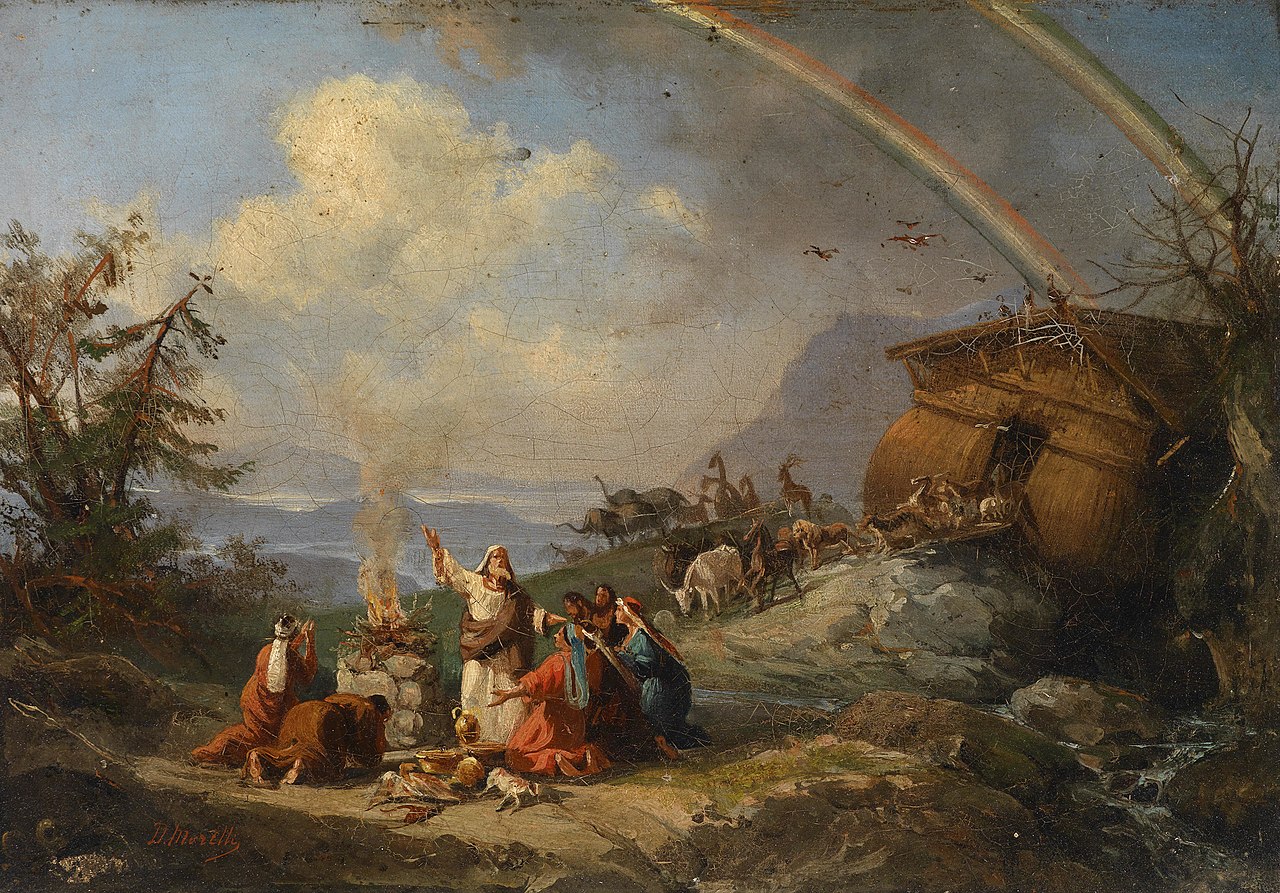
This covenant that God made is not just for squirrels, though. After the flood waters receded and Noah and his family returned to dry ground, God made the covenant with all of humanity and with every living creature. God will never destroy the earth with a flood. This is the only time recorded in the Bible that God establishes a covenant with creatures!

And what a powerful covenant it is. Reeling from the immensity of lives lost in the flood, God is overwhelmed. God promises never again to send a flood to destroy the earth. God’s creation, no matter how flawed, is beautiful and worthy of life. 

So, as a symbol of peace, God takes a weapon of war, the mighty bow, and puts it colorfully into the sky. What was once a symbol of death and destruction now promises life and hope.

This rainbow does not guarantee that God will never take a life again. There are a few instances in scripture where God directly kills individuals, and there are many more stories where God facilitates the destruction of entire peoples. Even so, never again has God caused a flood. Never again has God destroyed all of humanity. 

God has kept the promise, as Brett puts it, never to “exterminate” the human and animal races. God is not like the Daleks, who hate humans for their inferior nature. Instead, God sees us as beautiful creatures made in God’s own image. 

God’s covenant with Noah is the first of many that we will hear about this Lent. Each of the next weeks, we will hear of God creating covenants with the Israelites often through specific people, including Abraham and Moses. Each time, in unique ways, God promises to protect and multiply the Israelites. Each time, the Israelites won’t take long before they fail to show God respect. 

Take Noah for example. Immediately following today’s passage, not long after the rainbow is in the sky, Noah gets drunk and falls asleep naked. One of his sons sees him naked, and the other two carefully lay a blanket on their father without looking. Something must be left between the lines, though, because the son who found him naked is cursed, along with all his descendants. 

God never fails us, but we certainly have failed God. God needs to continue establishing covenants because we have failed and forgotten. Each of the covenants that we will hear about this Lent points forward to the ultimate covenant completed in Jesus. Through his life, death, and resurrection, Jesus has fulfilled every covenant that God has made. Through Jesus, God promises to protect and preserve us in this life and in the life to come. 

We experience this covenant through the season of Lent. The sign of this covenant is the cross. Whenever we see a cross - in church, on our jewelry, or anywhere around us, we remember that Christ died so that we might live. The crosses around us remind us of the grace that God gives us freely. Because of Christ’s sacrifice, we are forgiven of all our sins, known and unknown.

So, it is only fair that we share a similar grace with others. For those whom we share a covenant, giving this loving forgiveness is easier. For example, one way that I care for Kavod is by letting her out into the backyard whenever she wants, even if she was just out ten minutes ago. I enjoy watching her chase those squirrels, confident that she is too slow to catch any able bodied squirrel. 

I may not have a covenant with those squirrels, but I do show them grace by letting them live in my shed. I don’t blame them for finding protection from the bitterly cold winds. 


God has protected us from worldwide destruction during this life, and God will preserve us into the future, too. The least we can do is share some lovingkindness with others, both whom we share a relationship, and with the strangers, both human and animal alike. Amen.